
When Kendall Page was finalizing her will, her biggest question wasn’t about money — it was about who would take care of Wallis and Hadley.
Wallis, a 9-year-old corgi mix, and Hadley, a 4-year-old basset hound–pit bull mix, are Page’s only two “children,” as she describes them. So when the 67-year-old sat down to make her estate plans, she made sure they were part of it.
“For me, probably the biggest part of my will is for my pets,” Page said. “I don’t have two-legged children. My children are four-legged.”
For Page, writing her two dogs into her will was simply the next step in caring for them; it was a way to make sure the life they shared would continue after she and her spouse are gone.
That kind of planning stems from a question every dog owner faces eventually: what happens to my dog when I’m gone?
It’s a topic that recently resurfaced online after unfounded rumors spread that actress Diane Keaton planned to leave $5 million from her multimillion-dollar estate to her dog. The internet couldn’t resist, turning the idea into a talking point about wealth and eccentricity — but behind that fascination is a quieter story playing out across the country, where ordinary pet owners are doing the same thing, just without the spotlight.
Page found her answer in a niche of estate planning that ensures pets are cared for after their owners’ deaths. For devoted dog owners like her, it’s not Hollywood fantasy but practical peace of mind.
When pets become heirs
Despite the headlines, dogs can’t legally inherit property, but owners can direct part of their estate into a “pet trust” to ensure their animals are cared for long after they’re gone.
Page, who also happens to be an estate attorney in Chapel Hill, said these trusts are designed to cover everything from housing and veterinary care to daily routines and end-of-life planning for pets once their owners can no longer provide it.
Setting one up is far simpler than most people assume. “It doesn’t have to be complicated,” Page said. “You can include a clause in your will that says, ‘I leave X amount of dollars to a trustee for the care and maintenance of my pets.’ That person then has a fiduciary duty to use those funds only for the animals’ benefit.”
The trustee is responsible for distributing funds to pay for food, medical care and other expenses for as long as the pet lives, following the owner’s written instructions. And those directions can be as detailed or as flexible as the owner wants — specifying where and how the pet lives, how often it visits the vet, or even what brand of food it’s fed.
While Page’s own plan was drawn up in North Carolina, the legal framework behind it extends far beyond one state — and nowhere is that more evident than in Florida, which has one of the country’s most detailed statutes governing pet trusts.
David Goldman, an estate attorney based in Jacksonville, said these trusts can be created while an owner is alive or written into a will to take effect after death. Either way, they operate as irrevocable trusts — complete with their own tax ID and annual reporting requirements — and the amount must be “reasonably calculated” to meet the animal’s lifetime needs.
“You can’t technically leave your estate to an animal,” Goldman said. “The trust holds the money for their care, and anything left over goes to a remainder beneficiary — often family, a charity, or a rescue organization.”
Similar statutes now exist in every U.S. state, though the details — like tax rules or enforcement mechanisms — vary. Attorneys typically advise clients to set aside $10,000 to $15,000 per pet for care, Page said. For most of her clients, the motivation isn’t financial.
“They look at it as a responsibility,” she said. “They take it seriously when they allocate funds.”
Who’s left At home
Leaving everything to a pet might sound eccentric, but for many Americans, it isn’t far-fetched. With more people living alone — single-person households now make up nearly 30 percent of the country, according to the U.S. Census — fewer families are raising children, and pets have quietly taken on the role of companion and heir.
The share of U.S. adults who say they never plan to have kids has doubled over the past two decades, rising from about 14 percent in 2002 to nearly 29 percent in 2023, according to recent surveys. Among adults 55 and older, roughly one in six has no biological children, Census data show.
“For me, probably the biggest part of my will is for my pets,” Page said. “I don’t have two-legged children. My children are four-legged.”
That gap has left thousands of aging pet owners without an immediate next of kin, and for many, their dogs have long filled that role.
Page is one of them. Like many of her clients, she doesn’t have children, and that absence, she said, is what led her to make formal plans for her pets’ care — something nearly half of U.S. pet owners report having done in some form, according to one national survey.
But for those who don’t, the outcome can be devastating. A 2024 analysis by The Zebra found that one in ten animals surrendered to U.S. shelters each year arrive after their owner has died.
Tens of thousands of pets lose their homes not because of neglect or cruelty, but simply because no one was left to claim them. It’s a quiet crisis shelters deal with every year, and one that’s only grown as facilities struggle with record intake numbers, staffing shortages and limited space.
For organizations trying to manage the those unexpected surrenders, estate plans and legacy programs aren’t just about sentiment; they’re a form of prevention. It’s a way to keep loved animals from becoming part of the system in the first place.
The business of aftercare
When dogs outlive their owners, someone has to step in, and for a growing number of people, that plan is already in place. But for those without family, a small but growing network of organizations has begun to take on that responsibility.
Programs like Paws4ever’s Legacy Care, based in North Carolina, help pet owners plan for what happens to their animals after they’re gone.
Whitney Zoghby, the group’s executive director, said the program currently has about 50 enrollees — most of them 50 or older, about half married and the rest single or without heirs to take their pets.
Most people enroll as a long-term safeguard, though the organization also steps in for owners facing serious illness or planning for the end of their lives who need immediate placement for their pets, Zoghby said.
It’s a model built on foresight, and one that’s gaining traction far beyond North Carolina.
In Florida, the need for these programs is evident. The state’s large senior population — combined with its deep pet culture — has created a unique convergence: more people planning not just for themselves, but for their dogs too.
Sue Martino, executive director of The Pet Project in Fort Lauderdale, said demand for pet legacy programs in the area has grown, especially as more owners who’ve relocated to the area age or face health challenges without family nearby.
Even when relatives are in the picture, Martino said, it doesn’t always mean there’s a safety net. Some families already have pets of their own, or they simply can’t — or don’t want to — take on another.
That uncertainty is why she and others urge owners to put formal plans in writing, instead of assuming someone else will step in when the time comes.
The rise of these programs reflects a shift in how Americans think about pets not as property anymore, but as family members worth planning for. In the past two months alone, the group’s Pet Legacy program has added eight new pets — part of the 65 animals and families enrolled since it began two years ago.
But as enrollment grows, the next question is how owners pay for it — and what they’re willing to leave behind to ensure their pets’ care.
What it costs to keep caring
The financial side of pet estate planning varies for every owner. At Paws4ever, Zoghby said enrollment in the legacy program costs $1,000, with an additional $15,000 per pet typically paid through the owner’s estate.
“Some people have a trust set aside for their pets,” Zoghby said. “Others keep the money in a bank account or in stocks — whatever works best for them and their lawyer or financial advisor.”
Zoghby said the organization stays flexible on how payments are made, as long as the funds are readily available when the time comes.
For some owners, those plans extend well beyond setting aside cash. Estate assets like insurance policies, savings accounts, investments — even real estate — are used to fund a pet’s care.
Page, who is enrolled in Paws4ever’s Legacy Care program, plans to leave her house to her two dogs so they can live there until they die, even setting aside funds for taxes and upkeep to ensure it remains livable for as long as they do.
The caretaker she designated already looks after Wallis and Hadley when she’s away and will move into the house to keep their lives consistent until they’re gone.
Afterward, the property will be sold by the organization to cover their remaining care costs, with any surplus donated back to support Paws4ever’s work.
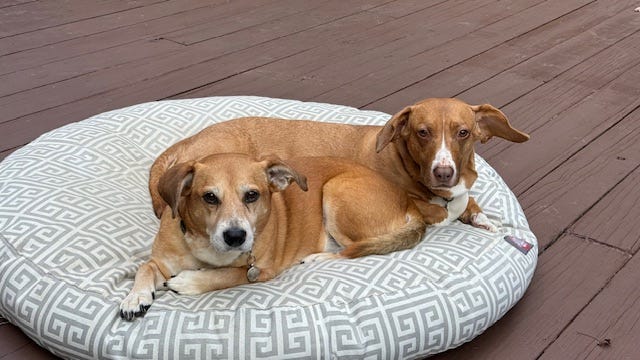
For Page, it’s not a financial decision so much as a way to preserve what feels familiar. Her dogs already have everything they know under that roof — the yard where they play, the rooms where they sleep, the daily rhythms that keep them grounded. She said she saw no reason to take that away.
In Florida, Martino said another client has arranged something similar — even paying a caretaker an undisclosed salary to live in the home with the dogs until they die.
“It’s like if you have children, you provide for them,” Martino said. “So you should be doing the same thing for your animals. I mean, it’s just a no-brainer.”
It’s a reminder that for some, a house is part of the safety net they’ve built together, for both themselves and their pets.
Inheriting a new life
For pets that eventually enter a legacy program, the adjustment can be disorienting. Even with months of planning, nothing can fully prepare anyone — let alone an animal — for the loss of a familiar home.
At the North Carolina facility, Zoghby said staff try to soften that change however they can. Legacy pets arrive through a separate intake process, away from the noise and stress of the main shelter, and are surrounded by pieces from their old life — a favorite toy, a worn blanket, or sometimes even the couch they once napped on.
“The transition’s obviously going to be difficult for the animal, but we want to try to make it as least stressful as possible,” Zoghby said.
On average, legacy pets spend one to three months in the program, far less time than most animals at the regular shelter, Zoghby said. Each comes with what she calls a “special story,” a glimpse of the life they had before. That history, she said, often helps them stand out to potential adopters and find new homes more quickly.
These programs offer more than logistics. For the owners who enroll in them, that care becomes a kind of inheritance — something they can pass on in place of wealth or family.
What they’re really leaving behind isn’t money or property but a quiet reassurance that love, once given, won’t disappear when they do.
What pet estates say about us
Celebrities have long fueled fascination with the idea of leaving fortunes to pets — from the verified estates of Leona Helmsley and designer Alexander McQueen to the enduring rumors surrounding Betty White and, more recently, Dianne Keaton. Those stories tend to make the idea sound eccentric, as a spectacle of wealth and excess but the truth is far more ordinary — and much more telling.
The size of the estate doesn’t reflect the depth of affection; the act itself does. What’s changing now is who’s doing it.
Everyday pet owners are beginning to make the same plans, not out of extravagance but out of love — a quiet acknowledgment that devotion doesn’t end with a person’s lifetime.
But within that kind of planning, there’s still an enormous privilege. As Page points out, setting aside tens of thousands of dollars — or even a house — for a pet’s future is something only some people can realistically do.
“It’s a luxury I’m glad I have,” Page said. “It feels responsible. It feels heartfelt. It feels like something that I don’t think twice about.”
In the end, it isn’t really about money or planning at all. It’s about reciprocity — the human impulse to give back just a fraction of the loyalty dogs spend their lives giving us.