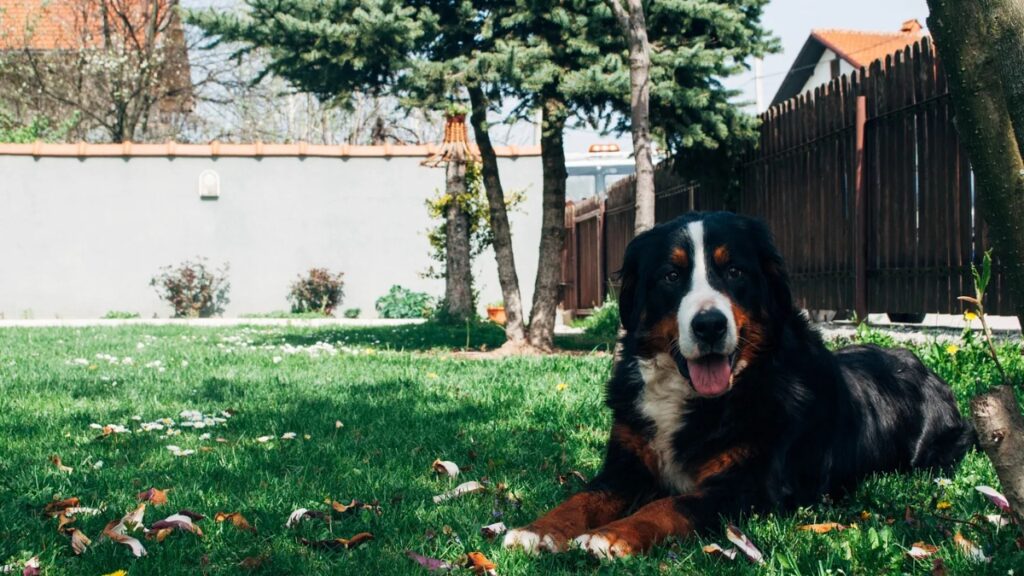

A backyard used to be a dog’s first promise of freedom.
It was the simplest kind of independence — barking at the fence, rolling in the grass, finding the sun, or moving to the shade — all without permission.
But as neighborhoods pack in closer and home lots shrink, that shift is reshaping daily life for the dogs who live there. Yards are getting smaller, more paved, more shared. The space that once gave them room to run is being redesigned around people’s needs for storage, patios and square footage.
So what happens to our dogs when the space that once defined their freedom is no longer guaranteed? Or maybe the better question is whether dogs ever needed that freedom in the first place.
The myth of the backyard dog
For generations, the private backyard has been seen as essential, a symbol of both good ownership and good living — and where most dog owners still believe their pets truly belong.
But experts say the belief that a dog “needs” a yard has more to do with convenience and tradition than canine psychology. Dogs, they argue, thrive on stimulation, routine and time spent with their people — things that don’t depend on property lines.
It’s something Alex Abreu, a professional dog trainer in Jacksonville, Florida, hears every day. For him, the question isn’t whether dogs have a yard — it’s how their owners use it. Used intentionally, he said, a yard can be a “controlled environment,” ideal for off-leash training and confidence building, especially for puppies learning recall.
Even with that understanding, many owners still get it wrong. “The people that want a bigger yard so their dog can burn more energy don’t understand that they don’t need to do that, they just need to train their dog,” Abreu said. “But training your dog becomes so much easier if you have a big yard.”
In many newer developments, small lots are often designed without fencing between homes, creating shared backyards. The open layout makes properties feel larger and more connected, but it also blurs boundaries in ways that can be risky for dogs. “Oh my God, it’s horrible,” Abreu said. “I tell my clients, you don’t want your dog out there — not until he’s not reactive.”
Abreu said the same risks apply to dog parks, which he avoids altogether. Dogs pick up behaviors from one another, he explained, and when overstimulated or untrained dogs mix, bad habits like barking, biting and jumping can spread fast — and undo months of training.
These issues often appear in shared community spaces, too — unpredictable interactions that can lead to conflicts, injuries, or illness when vaccinations aren’t up to date, he said. Public spaces rely on shared responsibility, meaning one owner’s lapse in training or care can affect everyone else.
For all his caveats, Abreu still prefers a yard. The privacy and predictability, he noted, give owners a rare chance to work with their dogs without distraction — something that’s hard to replicate anywhere else.
Yet that kind of space — private, predictable and personal — is becoming harder to find. Across the country, the yards that once defined dog ownership are disappearing, even as the number of dogs keeps growing.
The loss of backyard space doesn’t just change where dogs play; it changes how home life feels. The backyard has always been what blurred the lines between indoors and outdoors. It’s where movement is free and rules were few for dogs. But as that space gets tighter and more managed, what’s fading isn’t the yard itself, but moreso the small freedoms that once came with it.
Shrinking yards, shared solutions
Dogs are part of nearly half of all U.S. households, and more families continue to adopt each year. While the demand for pets continues to grow, the suburban yards that once defined dog ownership keep shrinking.
Nearly two-thirds of new single-family homes now sit on lots smaller than 9,000 square feet, according to the U.S. Census Bureau. With houses averaging about 2,200 square feet, that leaves only a modest stretch of lawn — far less than in decades past.
Once you account for setbacks, utility easements, fencing, driveways, patios, sheds and landscaping, the open ground where your dog can actually run and play is only a fraction of the “yard” you think you’re getting. And rising land prices squeeze that space even more, while local planning boards cut setbacks and lot minimums to keep up with growth.
According to a Redfin analysis, renter households are now growing faster than homeowner households, which means more pets are living without private yards altogether — and often under limits on size, breed, or number of dogs allowed. Even in communities where yards do exist, homeowners associations (HOAs) can impose similar rules, from leash requirements in common areas to bans on fences or dog runs.
The result: fewer options for exercising and accommodating dogs at home, and a greater reliance on shared parks and trails to fill the gap.
The pressure to fit more homes on smaller lots has also changed how builders think about community design. Instead of large private yards, many new developments now offer pocket parks, dog runs and community trails as selling points.
Matt Devereaux, president of Taylor Morrison’s Jacksonville division, said the company plans each neighborhood around how its residents — and their pets — actually live.
“We look at our buyer demographic and say, who is our buyer demographic in this market? And how do we serve them the best?” Devereaux said. “In a lot of our communities we do dog parks. Not every community, but there are dog parks. And we know that pets are like children.”
Even so, he said, private yards remain a top priority for pet owners. “That’s what people really look for. They want their pets to be able to go outside and roam.”
But, builders don’t always have the final say. In master-planned developments, decisions about open space and amenities are often set by the developer long before home construction begins. Even when there’s flexibility, zoning rules and land constraints limit what’s possible.
While those limits shape what builders can offer, they’ve also changed how many people experience outdoor spaces.
For many renters and first-time buyers, these shared green spaces function as a stand-in backyard, offering dogs variety and stimulation and giving owners a place to gather. They bring a social dimension — for both people and pets — that a private yard can’t provide.
Trainers, like Abreu, say the shift is changing how dogs spend time outside, as more owners rely on shared parks and structured walks instead of private yards.
Yard or no yard: Does it matter?
For dogs, a yard offers an outdoor area to explore smells, sights and sounds on their own terms, reducing boredom and frustration. It’s a confined place to roam and decompress.
But without that outdoor outlet, dogs end up losing a sense of control over their environment — and studies have shown that lack of autonomy can lead to higher stress levels and greater reactivity to everyday triggers.
Researchers say this kind of sensory deprivation can build frustration and anxiety over time. Without an outlet, that pent-up energy has nowhere to go — so it comes out through behavior: pacing, barking, destructive chewing or excessive licking and grooming.
That access to outdoor spaces is how behavriorists say that dogs can help self-regulate, but it isn’t the same as getting exercise. Most dogs use the yard for short bursts of activity rather than long play sessions. But that quick access is what gives them agency: a chance to choose when to explore and when to retreat, which experts link to lower stress.
Indoors, everything stays the same; the smells, sounds and scenery never change, leaving little room for the type of sensory variety that helps keep a dog’s brain engaged.
So as new homes shrink their outdoor spaces, what’s disappearing is one of the few environments where a dog can act freely without a leash or command — a simple freedom that keeps them regulated.
But by the time buyers start house hunting, the choice of yard versus no yard is often already made for them.
Jacksonville real estate agent Stephen Edmonds said that can make his job tricky, especially when clients have dogs. A yard and a fence almost always top their list of must-haves, he said — but those are decided long before a property ever hits the market.
“The backyard is amongst the most important things because that’s the one thing you really can’t change,” Edmonds said. “You can only do so much.”
And for some buyers, he added, that’s the dealbreaker.
In newer communities, smaller lots have simply become the norm. Buyers who want more space often have to look to older homes instead, like properties from the 1970s through early 2000s, when lot sizes were larger and designs more spread out.
That choice, though, comes with trade-offs: older homes tend to need more maintenance, while new builds come with incentives — no closing costs, mortgage-rate buydowns — that make them more affordable upfront.
The result: families often find themselves choosing between what’s best for their dogs and what’s best for their budgets.
But even with all of those practical adjustments, the sense of control is shifting. The less freedom dogs have to explore on their own, the more their worlds depend on human schedules. And that quiet dependence is easy to miss, but it says a lot about how homes — and the life of dogs — are evolving.
Redefining freedom
What’s changing isn’t so much the size of our yards as what we expect from them.
The patch of grass that once symbolized privacy and ownership is giving way to shared lawns, smaller footprints and community spaces that are designed around efficiency.
For dogs, the adjustment is easier; maybe they don’t measure freedom so much in acres, but in access, stimulation and the moments that we give them, instead. Ten feet of grass can offer them the same satisfaction as a field, as long as it comes with attention, play and our presence.
For people, it’s harder. We still tend to equate freedom with square footage. But maybe the lesson from our dogs is much simpler: freedom isn’t how much space you have, it’s how you use it — and who you share it with.