Heartworm disease is spreading across the United States.
New data from the American Heartworm Society and Companion Animal Parasite Council shows heartworm remains fixed in the Southeast, including Florida, while also emerging in areas once considered low-risk.
The findings, released for Heartworm Prevention Month in April, are prompting renewed calls from experts and veterinarians for year-round prevention, suggesting that protection isn’t keeping pace with the parasite’s spread.
The latest incidence map from AHS, released Wednesday, shows heartworm remains most prevalent across the Southeast, particularly along the Atlantic Coast and the Mississippi River.
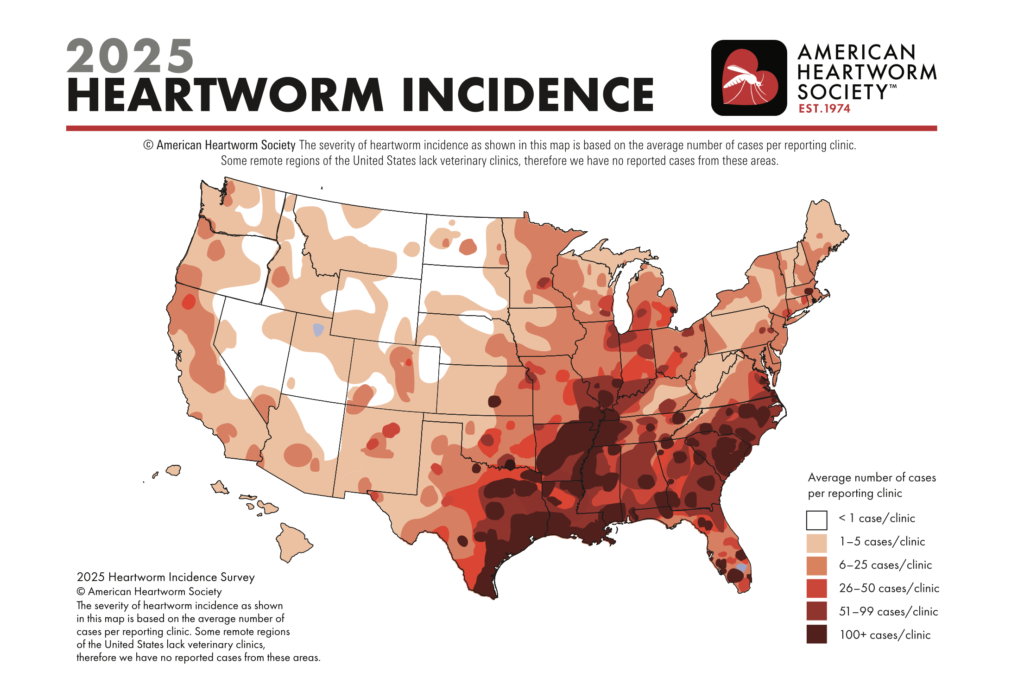
The map, based on the average number of heartworm-positive cases reported per clinic, reflects data collected in 2025 and shows heartworm remains most concentrated in the Deep South, stretching from eastern Texas across Louisiana, Mississippi, Alabama and Georgia into parts of the Carolinas, according to AHS.
For the first time, Texas ranked No. 1 in the AHS survey, while Florida remained firmly within that higher-incidence zone.
But the parasite is no longer confined to those regions, with areas once considered historically low-risk, including the central U.S. and parts of the West and North, now emerging as zones of concern.
Dr. Marisa Koyo Ames, president of AHS and an associate professor at the University of California, Davis, School of Veterinary Medicine, said there are multiple factors.
“Some of it’s climatologic, others natural disaster, especially in the Gulf Coast. And then, of course, humans being impacted by the ability to care for their pet because of [a] natural disaster,” Ames said in an interview.
In states such as Florida and California, where hurricanes and wildfires can displace large numbers of pets, shelters and rescue groups may transfer dogs across state lines to relieve crowding. Evacuated families may relocate with their animals as well.
Infected dogs moving through those channels could introduce heartworm into areas where it’s historically been less common, Ames said, so long as local mosquito populations and adequate climate are able to transmit the parasite.
CAPC’s forecast echoes those same findings. While the AHS survey reflects reported cases from 2025, CAPC’s 2026 outlook draws on millions of diagnostic tests to anticipate where risk is expected to persist or intensify.
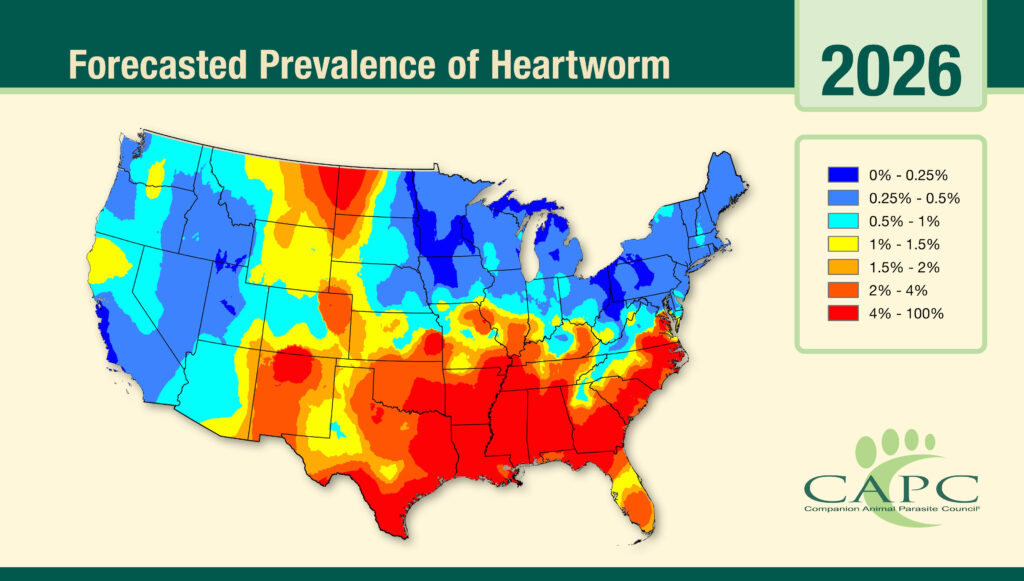
“Vector-borne disease risk continues to expand – and not in straight lines,” Dr. Kathryn E. Reif, an associate professor at Auburn University and a CAPC board member, said in a statement. “Land use changes, pet travel, wildlife dynamics, and climate-driven warming and extreme weather are accelerating shifts in where and when these vectors spread.”
In Florida, veterinarians say the risk for dog owners is obvious. Dr. Jay Schaub, a veterinarian and clinical assistant professor at the University of Florida College of Veterinary Medicine, has already treated a handful of positive heartworm cases this year, which he described as “a little unusual” for this early in the season.
Because heartworm doesn’t show up immediately after infection, it can take about six months for an infected dog to test positive, he said, meaning many of the cases showing up now likely trace back to mosquito exposure in the fall or early winter — seasons when some pet owners may assume the risk has eased.
“If you’ve looked at the prevalence maps, the answer is that Florida is a high-risk state. If you think about it in terms of our environment and our weather, it’s not really surprising,” Schaub said. “There’s very few times a year when we don’t have to worry about mosquitoes.”
That lag can make the disease easier to underestimate, even in a state with year-round risk. In Florida, Schaub said, that’s exactly why veterinarians recommend heartworm prevention for every dog and cat throughout the year, unless there is a medical reason not to.
But the message can be harder to get across in areas where mosquito control is common, although insufficient. In many gated communities and neighborhoods across the state, residents pay for regular spraying through homeowners associations and community development districts, and some counties also spray to limit certain mosquito-borne diseases.
Schaub said that can create a false sense of security for pet owners who assume those efforts are enough to protect their animals from heartworm.
But even as incidence maps shifts, veterinarians say one problem has not: getting dog owners to keep up with heartworm prevention.
According to AHS market survey provided to HomeFetch, veterinarians are still struggling to get dogs on consistent prevention, with 62% citing owners declining annual heartworm prevention as a problem and 70% saying client compliance with year-round dosing remains an important concern.
Ames said part of that gap may come down to owner education. Many dog owners assume a product that covers fleas and ticks also protects against heartworm, when that is not always the case.
In some situations, dogs may need separate medications to cover both heartworm and external parasites, creating confusion about what protection they are actually getting.
That confusion may also help explain a broader disconnect among dog owners. In a 2024 Banfield Pet Hospital study, 40% of pet owners said they did not believe their pet was at risk of contracting heartworm, and nearly 30% said their dog was not on any heartworm preventive.
Keeping a dog on multiple preventives year-round adds up, Ames said, particularly for pet owners already facing higher veterinary and pet care expenses.
According to CareCredit, heartworm prevention for dogs averages $16 a month, with annual heartworm testing adding around $57, bringing the yearly total to roughly $250 before any separate flea-and-tick medication.
But even when pet owners understand the cost of prevention, the danger of going without it may still feel distant, Schaub said.
“Unless you’ve ever seen a dog or a cat with severe heartworm disease or in heart failure or passed away or something as a result of that disease, it might not really strike as close to home for them,” Schaub said. “So, we understand that it’s not easy to understand the diseases that you’re not actually seeing, but we’re constantly working to talk about that.”