
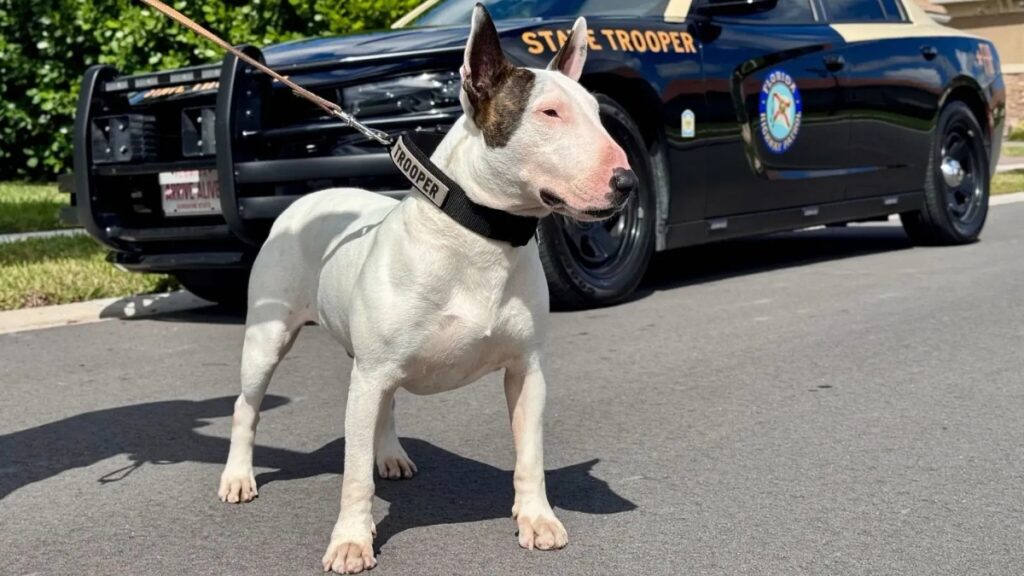

Trooper was still tied to the fence when floodwaters crept up to his chest.
His owner, Giovanny Aldama Garcia, 23, from Ruskin, Fla., had fled ahead of Hurricane Milton back in Oct. 2024. But he left his 4-year-old bull terrier behind — tied to a fence on the side of Interstate 75, straining against his chain as the rain fell harder.
Florida Highway Patrol Trooper Orlando Morales spotted the dog and pulled him free — a miraculous rescue captured on the officer’s bodycam that would go viral.
A year later, Trooper’s story has become more than just a headline. On Wednesday, SB 150, also known as ‘Trooper’s Law,’ goes into effect in Florida, making it a third-degree felony to abandon pets outdoors during a declared natural disaster or mandatory evacuation.
Trooper’s Law underscores the neglect that many pets face during times of crisis. Under the measure, signed by Gov. Ron DeSantis back in May, abandoning an animal during a declared natural disaster or mandatory evacuation — such as a hurricane, tropical storm or tornado — is punishable by up to five years in prison and up to $10,000 in fines.
It also establishes a first-degree misdemeanor for pet owners who fail to provide sufficient food, water and exercise, or who abandon an animal outdoors.
Animal advocates say the law is overdue, pointing to past disasters, most notably Hurricane Katrina, when an estimated 100,000 to 250,000 pets were abandoned.
At the bill’s signing, DeSantis said there was a need to “prosecute those who are derelict in their duty to take care of their own pets.”
“This law, Trooper’s Law, sends a clear message: Florida will not tolerate cruelty towards animals, especially in times of crisis,” DeSantis said. “What happened to Trooper is unfortunately not an isolated incident. Across Florida, we’ve seen horrifying instances of animal cruelty that demand a stronger response from our justice system.”
The law comes as millions of Floridians face the reality of preparing for hurricane season with pets at home. More than 10 million Floridians have a pet, according to the American Veterinary Medical Association. Yet only 46% of pet owners nationwide report having a prepared plan in place in the event of a natural disaster, per a 2021 ASPCA survey.
That survey also found that at least one in five pet owners had evacuated their homes due to a natural disaster, but nearly half left at least one pet behind.
That gap can become deadly during hurricanes, when pet owners may have only hours to evacuate and the few shelters that accept pets fill up almost immediately. First responders often end up on the front lines of those decisions, pulling frightened dogs from flooded yards or finding them tethered outside empty homes.
Alyssa Miller-Hurley, vice president of government affairs for Pet Advocacy Network called the legislation a “common sense law.”
“There’s never an acceptable excuse for such gross animal cruelty and neglect, even during an emergency,” Miller-Hurley said in a May statement. “Florida has long been a leader in animal welfare, and by signing Trooper’s Law, Gov. DeSantis will reaffirm the state’s commitment to protecting some of its most vulnerable residents — its pets.”
Preparing your dog for a disaster
Florida is one of the most disaster-prone states in the country, and when evacuation orders come, pet owners often have only hours to make life-saving decisions. Having a plan in place ahead of time can mean the difference between protecting your dog and leaving them at risk.
Here’s what dog owners should put in place before the next storm:
- Find shelter options early. Not all county shelters accept pets, and hotels that do may book up quickly during a mandatory evacuation. Know where you can go with your dog before a storm.
- Keep paperwork ready. Vaccination records, ID tags and microchip details are often required at shelters or boarding facilities. Keep them in a waterproof folder or save them digitally.
- Build a pet kit. Stock several days’ worth of food and water, medications, a leash and collar, plus a secure crate or carrier.
- Plan for comfort. Bring blankets or toys to help ease stress for dogs in crowded, unfamiliar spaces.
- Leave early. Leaving early helps avoid jammed roads or full shelters and reduces the risk of having to leave your dog behind.

I’m all for this. Furthermore, it would be wonderful to have more places for these people and the animals to go. More shelters for all. Come to think of it, we all need that Now, not just in emergencies.
I would never leave my pets behind. So cruel. Even if I had to find a place to park and stay in the car with them. You can drive far enough away to be safe to park. Anyone who would leave their pets behind does not deserve to have a pet of ANY kind from that day forward. They should lift pet restrictions at hotels during natural disasters. No pet should have to endure a disaster alone. Only hateful cruel humans would leave their pets behind. I hope people like this grow a conscience while sitting in their local safe place. I hope anyone who has, or thinks it’s ok to leave your pet behind suffers the same fate their as their animals. Complete and total terror. You will have to answer for your cruelty one day. Wish I could watch y’all squirm before the Lord and explain why they deserted and left their animals to die. We are all Gods creatures. If you are one of those people, I pray you will get the help you need to overcome your mental illness.