
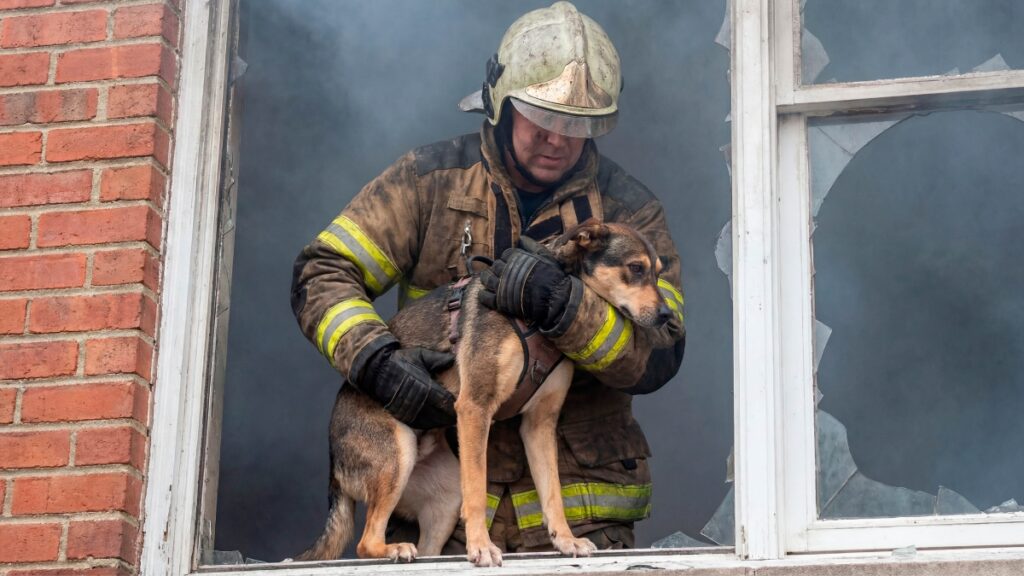

A house fire is one of the most measured emergencies in America. The fire-rescue system can tell you how fast the first engine arrived, how long crews stayed inside and exactly how many people crossed the threshold alive.
The only thing it doesn’t track — or even plan for — is whether the family pet made it out alive.
Across much of the country, fire response protocols have only ever accounted for people. Pets are treated more as an add-on than a core concern in the systems that track who is inside a burning home.
All of that has added up to the system we have today: one that is very good at protecting people but still leaves our four-legged companions as an afterthought.
The fires we don’t count
Pets end up in house fires more often than people realize. The American Veterinary Medical Association estimates that about 500,000 pets are affected by home fires each year and roughly 40,000 die. The National Fire Protection Association, a private nonprofit that writes model fire codes used across the country, estimates that pets and other animals also unintentionally start around 750 home fires a year.
But these numbers are only estimates. Fire agencies across the U.S. don’t formally track pet outcomes, and there’s no national system that records how many animals survive or are lost. In most reports, pets are recorded as property, not casualties — which means the actual toll is higher than what’s reflected in the numbers.
Dr. Jake Wolf, an emergency and critical care veterinarian at the University of Florida’s Small Animal Hospital, said he treats about three to four pets a month for fire-related injuries, most often from smoke inhalation. Most of those patients are dogs, largely because they’re the ones firefighters and owners are more likely to find.
Cats rarely reach the hospital at all, Wolf said. They tend to hide under beds, behind heavy furniture or inside closets and cabinets — the kinds of spaces firefighters can’t access quickly, especially in low visibility. By the time crews reach them, many have already been overtaken by the fumes.
The pets that do make it out alive often need oxygen support, time in intensive care and monitoring for delayed lung damage, he said.
Once smoke fills a room, survival comes down to mere seconds. Most pets that die in house fires don’t actually burn — they suffocate. “It’s very rare to see burn injuries from fires,” Dr. Wolf said. “In the four years I’ve been here at the University of Florida, I haven’t seen any burn injuries from house fires.”
The systems that don’t protect them
The medical realities Dr. Wolf described don’t happen in a vacuum. What happens next — whether a pet is found, rescued or even noticed at all in an emergency — depends on a larger system that was never built with them in mind to begin with.
Much of that is set upstream, in the codes that shape how homes are built and what a “proper” response to a house fire looks like, from how escape routes are laid out to how occupants are counted. But while many of those rules are based on NFPA’s national fire standards, the organization acknowledged that its guidance on residential fires does not include any provisions for pets.
“While NFPA provides public education messaging about the ways in which pet owners can work to ensure their pets’ safety from home fires, none of our codes or standards that cover residential occupancies include specific provisions for pets or animals,” the organization stated in an email.
That omission sits against a different reality inside homes, where 94 million U.S. households — about 71 percent — have at least one pet, according to the American Pet Products Association, and surveys show most owners describe those animals as family.
How fires start now
Fires that threaten pets don’t follow a single pattern. Some still start the old-fashioned way — a candle left burning, a pan left on the stove, a space heater pushed too close to a blanket. But firefighters say they’re now up against a different mix of hazards than a generation ago, as rechargeable devices and lithium-ion batteries sit in nearly every corner of the house.
Those batteries are inside phone chargers, e-bikes, grooming tools, pet cameras and automatic feeders — and they can fail fast, often without warning. If one overheats or gets chewed open, it can spark and ignite nearby furniture and fabrics long before anyone notices.
Pets — especially dogs — have also been known to turn these devices into chew toys, and the consequences can be explosive.
But the real challenge, Dr. Wolf said, is that many of these fires happen when no one is home. If a dog knocks over a candle or turns on a stove — and the owner isn’t there to hear the alarm — the only creature that’s aware of the danger is the pet itself. By the time smoke escapes through a window or a neighbor notices flames, the fire may have been burning long enough that the animal is already in serious trouble.
That lag between what’s happening inside and when someone calls for help is exactly what worries firefighters on the ground.
The calls without answers
Capt. Ryan Tussing, a firefighter in the Phoenix area, said most of the calls he responds to don’t come from the homeowner at all, but from neighbors or passersby who notice smoke and dial 911.
If no one’s home, crews pull up with no sense of how long the fire has been burning or whether an animal is inside. Response times, staffing levels and call volumes can vary widely between departments, shaping how quickly firefighters can reach a house and how long they can afford to search it once they arrive.
With more than 20 years in the fire service, Tussing has seen just how unpredictable those searches are. Pets don’t bolt to the front door the way people imagine, he said; they wedge under beds, into closets and behind furniture while heat and smoke fill up a room minute by minute.
“Over the years, I’ve carried out I don’t know how many pets that didn’t make it,” Tussing said. “And it’s not because we’re bad firemen, but because we don’t know they’re in there, we don’t know how many there are and we don’t know where they’re hiding.”
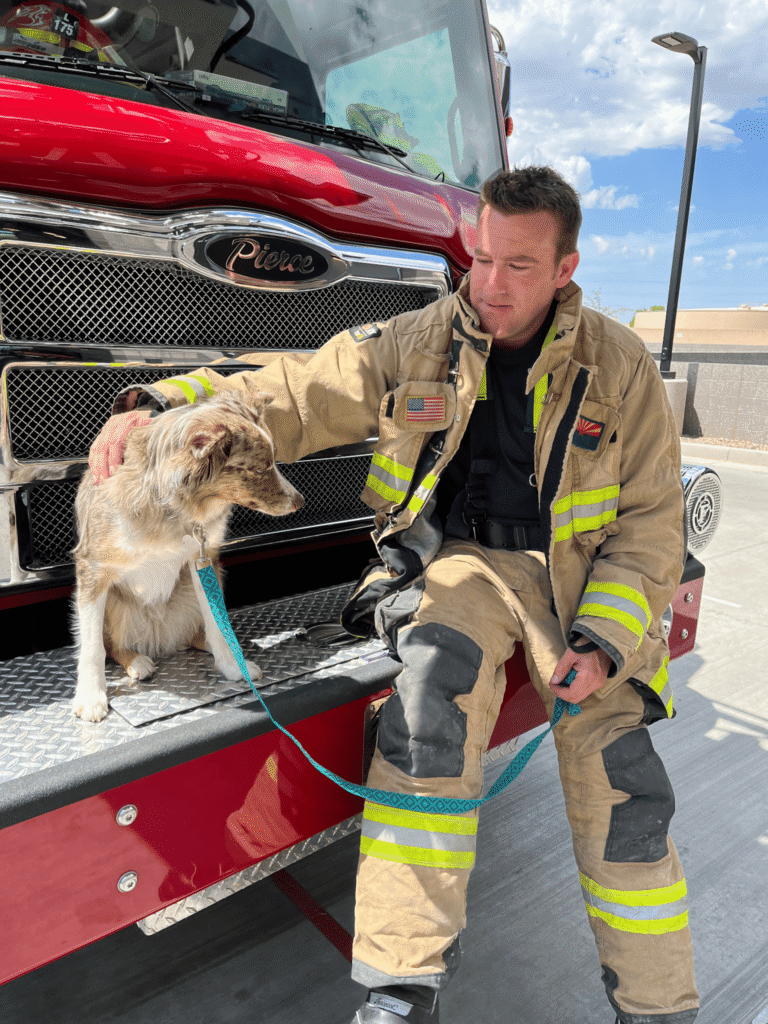
Those scenes don’t end when the fire is out, he said. Families want to know what happened to their animals, whether anyone had a chance to reach them and if there was anything else that could have been done.
At a house fire, firefighters triage their priorities: people, then fire, then whatever property can still be saved. Unless someone can tell them a pet is inside, there’s nothing in that sequence that redirects a crew to start searching under beds or digging through closets for a pet.
Calls like these left Tussing with a question he couldn’t shake: What if crews didn’t have to search for pets in a burning house blind?
The rescues we hope for
Most homes already have fire-safety essentials, like smoke alarms, because building codes require them. But even the smart systems people add on top of that, from Ring cameras to whole-home monitors, are designed to alert humans, not account for pets.
That gap is what Tussing fixated on. He brought the idea of a pet-focused alert to his twin brother, Rusty, an entrepreneur, and the two began sketching out what a tool like that would need to do.
The result was Rescue Retriever: a small, paw-shaped device that functions like a silent smoke detector for pets, signaling to emergency responders the room where an animal is likely sheltering when a fire breaks out.
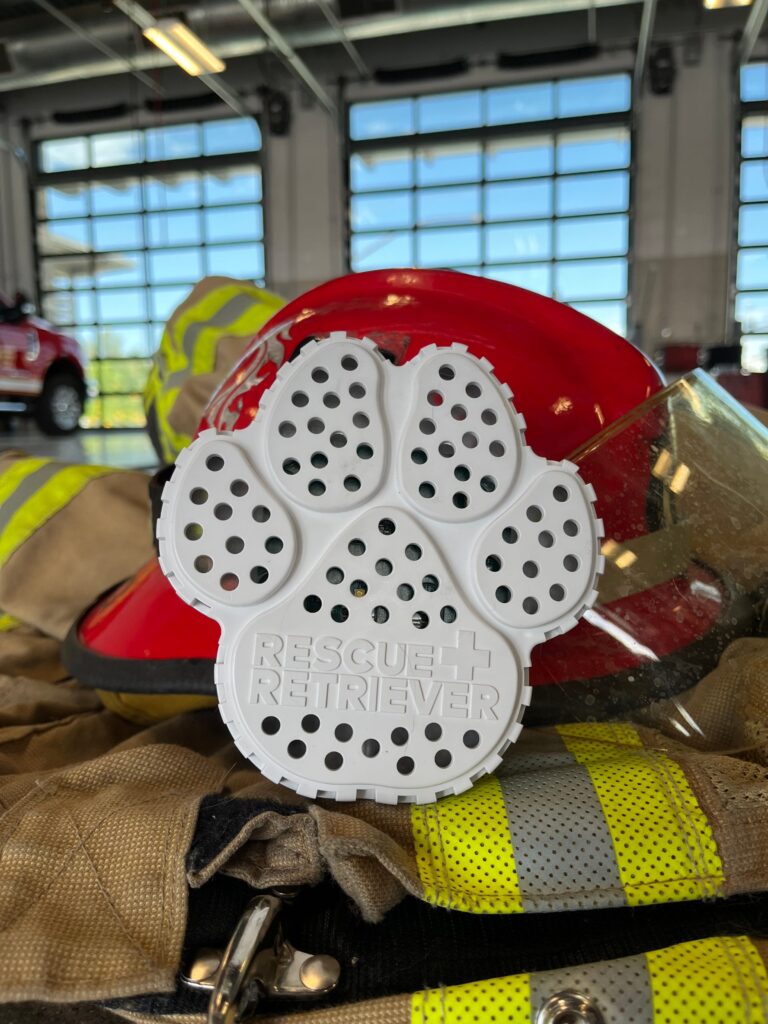
The device stays in the home, placed where a pet spends most of its time — a crate, a bed or the corner of the house the animal retreats to when it’s afraid. The idea is simple: give firefighters a clear place to look first.
When smoke triggers the unit, it emits a bright strobe. Its casing is made from heat-absorbent plastic, Tussing said, so it shows up as a distinct hot spot on a thermal imaging camera even through heavy smoke.
Each Rescue Retriever also includes a reflective window sticker designed to stand out through a firefighter’s face shield. It gives crews an immediate cue at the doorway that a pet may be inside and that the home has the system installed.
“Over the years, I’ve carried out I don’t know how many pets that didn’t make it,” Tussing said. “And it’s not because we’re bad firemen, but because we don’t know they’re in there, we don’t know how many there are and we don’t know where they’re hiding.”
Tussing said one customer was at church when her neighbor called to say her house was on fire. She begged him to try to save her dogs: a pair of Doberman pinscher parents and their litter of puppies. In her account to Tussing, the fire appeared to have started in the garage and pushed into the house.
The neighbor couldn’t make it through the front door because of the heat, she said, so he ran around to the back deck, opened the doors and saw the Rescue Retriever strobing through the smoke.
He managed to find and grab just one puppy from the litter. By the time anyone could get fully inside, the rest of the dogs — including both parents — were already dead. She believed they’d been overcome by smoke because, as a tall breed, they couldn’t crouch low enough to stay beneath it.
That kind of loss is what Tussing said he built Rescue Retriever to prevent.
“That’s the number one thing people want out of that house,” he said. “People consider their pets their family.”
The long road to adoption
Even if a tool like the Rescue Retriever works exactly as designed, the real challenge is scale — getting it into enough homes and into the routine of the crews who show up when those homes burn.
Every new tool needs to be vetted, tested and folded into existing protocols — a process that can take years. The equipment firefighters rely on now, like thermal cameras and gas monitors, became standard only after long cycles of evaluation, training and adoption.
NFPA noted in its email that it does not test, certify or endorse new fire-safety technologies; that vetting happens through independent testing labs. The organization did not address whether pet-focused tools might ever factor into codes or training standards.
Whether any device ever gets used in the field isn’t decided nationally, either. Each department — and often each fire chief — makes its own call on adopting new tools, usually under the limits of a tight budget.
A device built specifically for one step in that chain — identifying where a pet is sheltering in a burning home — sits outside the traditional pipeline. There’s no precedent for how it would be evaluated, where it would fit in the response sequence or how a department would even train around it.
The tool also has practical limits: it only helps if it’s installed in the right spot, maintained and able to withstand enough heat and smoke to be seen when crews arrive.
Some departments do carry pet oxygen mask kits, often donated by local groups, but those only come into play after a pet has been found and don’t solve the core problem: firefighters still have no reliable way to locate an animal inside a burning home.
At $43.99, Rescue Retriever is sold online and through small pet retailers, but its widest reach so far has come from community efforts rather than fire-department budgets, Tussing said. In Arizona, the Burn Foundation includes the device in smoke-detector walks for elderly and low-income residents. Arizona State University nursing students have promoted it during installation drives in Peoria. And in Sedona, a city-council–led program now sells the units out of the fire department’s administrative office.
In his own department, pet search-and-rescue has already been added to training for residential fires, Tussing said. The Rescue Retriever he prototyped and showed to his chief a few years ago is widely known within the department, but it has yet to be folded into official training protocols.
He has since started talking with departments in other cities about the device, trying to build familiarity and momentum, and said he’d like to see it used well beyond Phoenix.
Some chiefs have expressed interest, he said, but any adoption would still require local buy-in, testing and training before a crew could rely on it in an emergency. For now, the Rescue Retriever faces the same hurdle every new fire-service tool does: proving itself one department, one chief, one firehouse at a time.
On paper, little has changed: most fire codes still treat a burning home as a place filled only with people. But inside those homes, pet owners keep building lives around the animals they call family and hoping, if the worst happens, that someone will think to go back in for them, too.
